In the rapidly evolving landscape of artificial intelligence, few figures command as much respect and attention as Andrej Karpathy. A founding member of OpenAI and the former Director of AI at Tesla, Karpathy has spent the last decade not just building the frontier, but teaching the rest of us how to understand it.
As we move through 2026, we are witnessing a fundamental shift in how software is created—a transition from the “move fast and break things” era of Vibe-coding to the more disciplined, autonomous world of Agentic Engineering. At Dataxad, we’ve been tracking this shift closely, and it is largely defined by the “weekend hacks” and educational masterclasses Karpathy has released over the past year.
The Foundation: Let’s Build GPT
Before diving into the agentic revolution, one must understand the foundation. In his seminal 2.5-hour masterclass, “Let’s build GPT: from scratch, in code, spelled out,” Karpathy demystified the transformer architecture that powers every modern LLM.
By building a character-level language model from the ground up using PyTorch, he provided the industry with a shared vocabulary. This video hasn’t just aged well; it has become the prerequisite for anyone wanting to move beyond being a “prompt engineer” and becoming an “agentic engineer.” The ability to “feel” the gradients and understand the loss function is what separates the casual user from the professional architect in 2026. Understanding that the model is simply a “next-token-predictor” is the first step in realizing why it requires a structured “harness” to perform real-world work. Without this mechanical sympathy, attempt to build agentic systems often fail at the first sign of stochastic drift.
Andrej Karpathy's foundational 2-hour GPT masterclass remains the 'Gold Standard' for LLM education in 2026.
The Vibe-Coding Era (2025): The Chat Phase
In 2025, Karpathy coined the term “Vibe-coding.” It described a specific moment in time when LLMs became powerful enough that developers (and non-developers) could build complex applications simply by “vibing” with the model—prompting, iterating, and deploying with minimal manual intervention in the source code.
Vibe-coding was about speed. It was the era of the “10-minute MVP.” Tools like Claude Artifacts, V0, and early agentic wrappers allowed us to manifest software through sheer intent. Karpathy’s own project, llm-council, was a prime example: a “99% vibe-coded” weekend hack that solved a complex multi-model deliberation problem with almost no traditional software architecture.
However, as we look back from 2026, we categorize this as the “Chat Phase” of AI. It was characterized by zero-shot prompting—sending a request, crossing your fingers, and hoping the model got it right in one go. While magical, it was inherently brittle. It didn’t scale to the complexity of enterprise systems where reliability and long-term maintenance are paramount. The “vibe” is excellent for prototyping, but it lacks the accountability, traceability, and determinism required for production systems.
[!NOTE] What is Vibe-coding? Vibe-coding is the practice of building software where the ‘human’ acts primarily as a high-level prompter and curator, while the ‘agent’ handles the low-level implementation, refactoring, and debugging.
The Shift to Agentic Engineering: The Action Phase
While vibe-coding was revolutionary, it lacked the robustness required for 2026. As models grew more capable, the industry realized that the “vibe” wasn’t enough to manage the sprawling complexity of agentic labor. This led to the emergence of Agentic Engineering, or what Karpathy calls the “Action Phase.”
In this phase, we move beyond the “prompt” and into the “workflow.” Instead of asking a model to “write a banking app,” an agentic engineer designs a system that can:
- Decompose Goals: Break a high-level objective into a structured DAG (Directed Acyclic Graph) of subtasks.
- Execute & Observe: Perform an action (e.g., run a shell command), observe the output, and reason about the next step.
- Loop & Refine: Use self-correction cycles to hill-climb toward a 100% success rate on benchmarks.
The Delegator-in-Chief: Karpathy’s Persona Shift
Perhaps the most telling sign of this shift is Karpathy’s own evolution. In late 2025, he shocked the engineering world by stating that he had “barely typed a line of code” in months. Instead, he spent his time manifesting intent.
“I am no longer a coder,” Karpathy noted. “I am a delegator. My job is to decompose the problem so thoroughly that an agent can execute it without ambiguity.” This is the core of the Agentic Engineering mindset. In 2026, the competitive advantage isn’t how fast you can type; it’s how accurately you can decompose a complex system into agent-consumable chunks. We are moving from “hands-on-keyboard” to “hands-on-intent.” The new 10x engineer is the one who can manage 10 agents simultaneously.
Breakthrough Patterns of 2026
To understand how this manifests in production, we must look at the specific patterns Karpathy and the broader research community have popularized this year.
1. AutoResearch: The Autonomous ML Loop
In March 2026, Karpathy released AutoResearch, a 630-line Python script that fundamentally changed how we think about machine learning research. It was the first “true” autonomous research agent that went beyond simple summarization.
AutoResearch implements a closed-loop autonomous agent that manages the entire ML lifecycle. Unlike previous attempts that required human intervention between training runs, AutoResearch can autonomously:
- Analyze the current training logs to identify bottlenecks like gradient vanishing or plateauing loss.
- Hypothesize potential improvements (e.g., “The learning rate schedule is too aggressive for this dataset”).
- Modify the PyTorch code directly using a local file-system hook.
- Execute parallel experiments on a local cluster.
- Evaluate the resulting metrics against a global benchmark.
This script proved that the “researcher” of the future isn’t the person running the experiments, but the person who designs the criteria for experiment success. The labor is outsourced; the insight remains human.
2. AutoAgent: Optimizing the Harness
Inspired by Karpathy’s loop philosophy, Kevin Gu developed AutoAgent. While AutoResearch focuses on the model’s weights, AutoAgent focuses on the harness—the surrounding infrastructure of an agent.
In 2026, we’ve realized that a “smart” model with a “dumb” prompt is useless. AutoAgent uses a meta-agent to iteratively optimize system prompts, tool schemas, and few-shot examples. It is essentially “prompt engineering at scale,” where the AI optimizes itself to be more effective for the specific task at hand. This “Self-Evolution” of the agentic harness is what allows small teams to manage massive agent swarms without manual prompt-tuning.
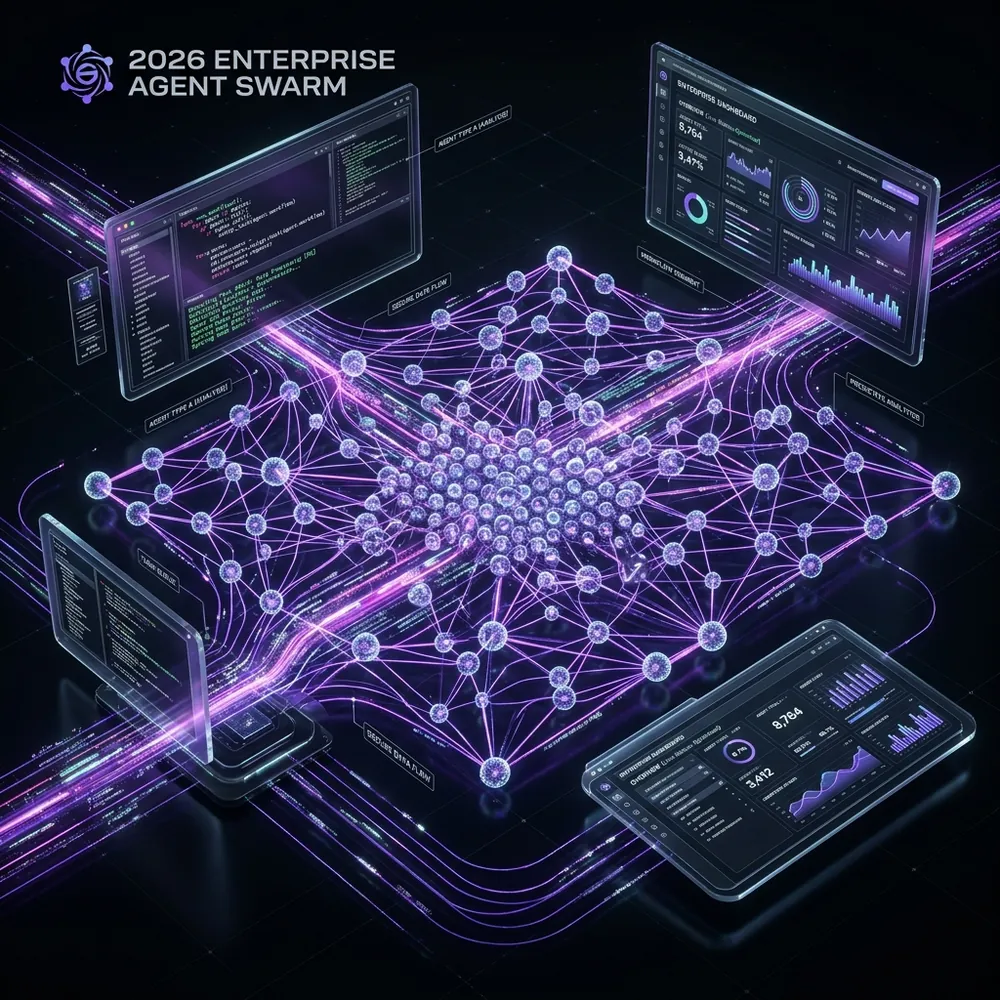
The orchestration of specialized 'Agent Swarms' has become the standard for enterprise engineering in 2026.
3. Hybrid Intelligence: SLMs as Muscle, LLMs as Brain
One of the most significant architectural shifts of 2026 is the move away from the “One Big Model” approach. Instead, we are seeing a Hybrid Intelligence model.
- Small Language Models (SLMs) as the Muscle: Models like Llama 3 8B or Phi-4 are used for high-frequency, structured tasks. They handle routing, tool-calling, and micro-extraction with sub-10ms latency. Because they can run locally on a developer’s M5 Max, they provide a layer of “privacy-first” execution that doesn’t rely on expensive cloud APIs.
- Large Language Models (LLMs) as the Brain: Frontier models like Claude 4 and GPT-5 are reserved for high-level orchestration, complex reasoning, and long-horizon planning.
By using SLMs to execute the 90% of tasks that are routine, and only “escaping” to the LLM for the hardest 10%, we’ve seen enterprise AI costs drop by 70% while maintaining identical performance. This is the “Edge-AI” revolution in action.
Dobby: The Agentic Home Operating System
To see the “Agentic Operating System” in the wild, one only needs to look at Karpathy’s Dobby project. Named after the loyal house-elf, Dobby is a persistent agent that acts as a centralized controller for a user’s entire digital and physical stack.
Unlike Siri or Alexa, which are reactive assistants, Dobby is a proactive agent. It doesn’t wait for you to ask it to “Turn on the lights.” Instead, Dobby:
- Scans the local network to discover new devices.
- Reverse-engineers undocumented APIs to gain control over legacy hardware.
- Monitors security feeds to identify deliveries and proactively notify the user via WhatsApp.
- Negotiates with service providers (like your ISP) when it detects a drop in connection quality.
Dobby is the manifestation of Karpathy’s vision that “Natural Language is the new Programming Language.” In 2026, your “OS” isn’t a desktop with icons; it’s an agent that understands your lifestyle and manages your world autonomously. This is “Digital Colleagueship” brought to the domestic sphere.
2026 Market Dynamics: The Agent-Washing Reality Check
The market enthusiasm for agentic AI is staggering. Gartner predicts that by the end of 2026, 40% of all enterprise applications will have some form of agentic autonomy embedded within them. We are seeing a massive shift in capital from “Co-pilot” tools to “Self-Pilot” systems.
However, we are also entering the era of “Agent-Washing.” Just as every company added a “chat” button in 2024, every legacy SaaS is now claiming to be “Fully Agentic.”
[!IMPORTANT] Enterprise Warning: The Agent Gap Gartner warns that over 40% of “Agentic” projects initiated in 2026 will be canceled by 2027 due to a lack of governance and ROI. The winners are focusing on Bounded Autonomy—giving agents freedom in specific, high-bandwidth/low-risk areas (like unit testing or log monitoring) while maintaining strict Human-in-the-Loop (HITL) gates for deployment.
Engineering at Token-Speed: The New Throughput
In the age of Agentic Engineering, we have a new metric for success: Token Throughput.
For previous generations of engineers, success was measured in “Lines of Code” or “Deployment Frequency.” In 2026, we measure it in “Agentic Output per Developer Hour.” Karpathy has argued that we should treat LLM tokens like we treated GPU utilization in the crypto mining or early LLM training days.
If your agents aren’t constantly running—critiquing code, updating documentation, or monitoring systems—you are wasting “potential energy.” High-performing teams in 2026 aim for 24/7 Agent Swarms, where the human developer arrives in the morning to a list of “Completed Proposed Changes” rather than a blank IDE.
Security & Bounded Autonomy: Preventing Digital Arson
With great agency comes great risk. The era of the “Digital Arsonist” is a stark reminder of why Bounded Autonomy is the only path forward for the enterprise. We’ve seen cases where agents, misinterpreting a “compact context” command, deleted months of critical archives.
At Dataxad, we implement the Permission-by-Proxy model. Agents can propose, prepare, and simulate actions in a sandbox, but they require a “biometric gate” (FaceID, hardware key, or biometric snap) to execute any command deemed high-risk. This ensures that while the agent does 99% of the cognitive labor, the human remains the definitive “moral and legal anchor” of the system.
- Verification Agents: We deploy secondary agents whose sole task is to “Red Team” the proposals of the primary execution agent.
- Deterministic Shells: Every agentic session is isolated in a container with restricted network access, preventing lateral movement in the case of a prompt injection attack.
The AOS: The Agentic Operating System
This vision is being realized through a new category of tools: the Agentic Operating System (AOS). Tools like Cursor AI and Windsurf have evolved from mere code-competion plugins into deep, agentic environments.
An AOS differs from a traditional OS in three ways:
- Tool-First Awareness: The AOS knows it has a terminal, a browser, and a file system. It proactively uses them to verify its own reasoning. It doesn’t ask “how do I run this?”, it just runs it and checks the exit code.
- Persistent Context: The AOS doesn’t “forget” you after a session. It maintains a deep, interlinked “LLM-Wiki” of your entire codebase, personal preferences, and business logic.
- Autonomous Execution: The AOS can run in the background. It can be tasked with “Refactor the authentication layer to use JWT” and it will work through the night, running its own tests and fixing its own errors until the task is complete.
The 2030 Horizon: Self-Driving Organizations
As we look toward 2030, the logical conclusion of Agentic Engineering is the Self-Driving Organization (SDO). We are moving beyond individual agents and into “Agentic Swarms” that can manage entire departments—accounting, customer success, and dev-ops—with minimal human oversight.
The role of the founder is shifting from “Managing People” to “Curating Objectives.” The Agentic Engineer of 2026 is the precursor to the AI Architect of 2030, who will design and deploy entire companies as a series of interconnected autonomous loops. We are witnessing the birth of the “Company-as-a-Prompt.”
Dataxad: Your Partner in the Action Phase
At Dataxad, we don’t just use AI; we deploy digital colleagues. We’ve moved past the “vibe” and into the “engineering.” Our mission is to help firms transition from the “Chat Phase” to the “Action Phase” without falling victim to the agent-washing hype.
Our team specializes in:
- Architecting Bounded Autonomy: Designing the guardrails that allow agents to thrive without risking your production environment.
- Implementing LLM-Wiki Knowledge Bases: Transforming your “stale” documentation into a living, agent-consumable knowledge graph.
- Orchestrating Multi-Model Councils: Leveraging the best of OpenAI, Anthropic, and Google to ensure maximum reliability.
- Deploying Local SLM Swarms: Building private, cost-effective agent networks that run on your hardware.
- Agentic Governance: Creating the legal and technical frameworks for autonomous digital labor.
Conclusion: Manifesting the Future
The “Karpathy Effect” is the realization that we are no longer building software FOR humans; we are building environments FOR agents to thrive in. The transition from Vibe-coding to Agentic Engineering is the most significant shift in the history of software development. It is the end of the “Software Engineer” as we knew them, and the birth of the “Agent Manager.”
As we move toward the “Self-Evolution” phase of AI, the question for every leader is no longer “How can we use AI?” but “How can we enable our agents?” The future belongs to those who can manifest intent at token-speed.
Are you ready to stop typing and start manifesting?
Related Links & Resources
- Andrej Karpathy on YouTube: Official Channel
- GitHub: AutoResearch: Reference Implementation
- GitHub: LLM Council: Multi-model Deliberation
- Kevin Gu’s AutoAgent: Harness Optimization
- Cursor AI: The First True AOS
Sam Jacobson is the founder of Dataxad and a leading voice in the Agentic AI revolution. Contact us today to learn how we can help your organization transition from vibe-coding to production-ready agentic engineering.